

Relationships & Healing
You Do Not Have to Forgive
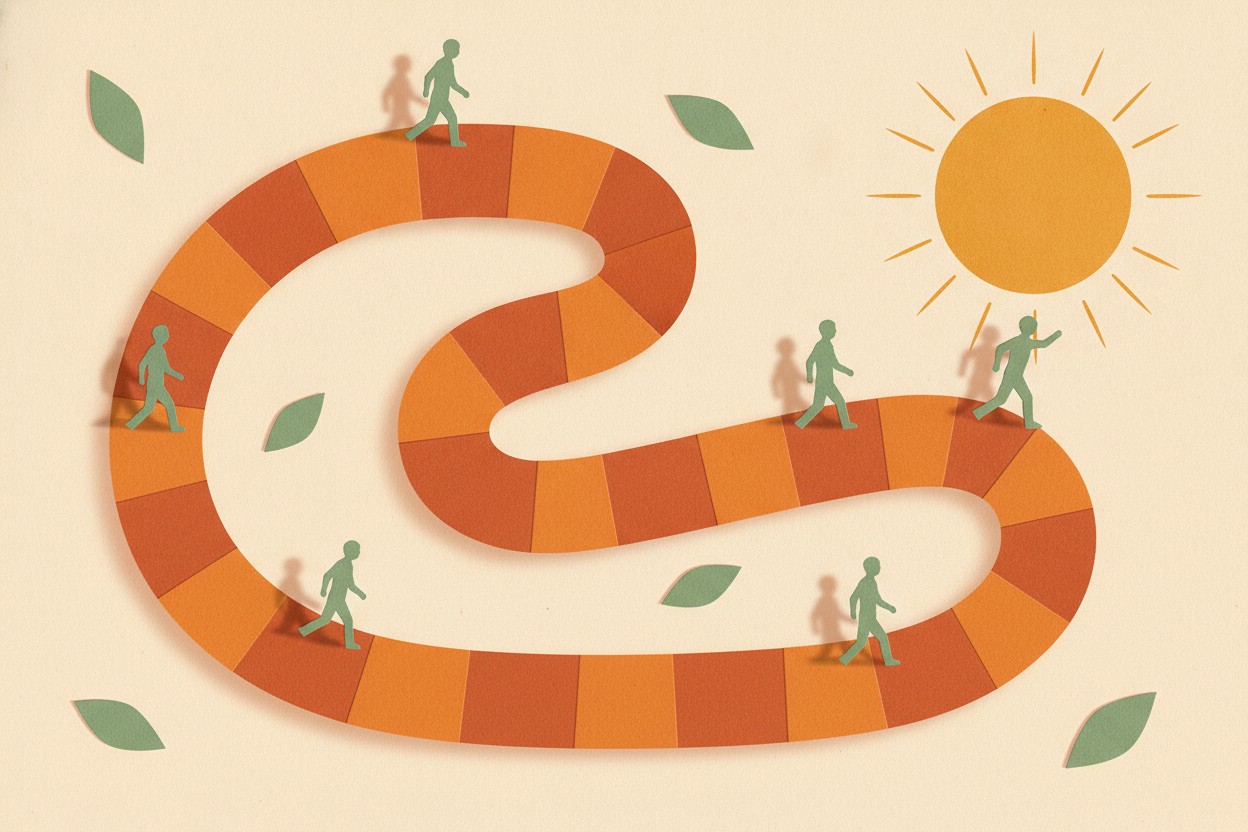
Why forgiveness pressure creates shame, what the research on forgiving found, and the two moves that help: compassion, and letting go of the story.
Read More →Dr Alla Demutska · Clinical Psychologist
by nurturing a healthier relationship
with yourself, with others
and the world around you.
30 minutes, online, one per person. A conversation to see whether we are a fit, not a therapy session.

Welcome
I'm a Clinical Psychologist and Clinical Director at The School of Positive Psychology in Singapore. Over fifteen years I have worked across psychiatric hospitals, outpatient programs and private practice in Melbourne, Singapore, and internationally, and taught and supervised master's and doctoral students. I now see clients online - which means wherever you are, we can work together.
My training spans the full range of evidence-based approaches: CBT, EMDR, Schema Therapy, ACT, DBT, and trauma-informed and somatic methods. I have supervised and taught clinicians at Masters and Doctorate level. I bring that depth - all of it - into the room with each person I work with.
Registered Clinical Psychologist endorsed by the Psychology Board of Australia. Board-Approved Supervisor. Member of the Singapore Psychological Society. What I offer is serious clinical expertise, and a genuine commitment to doing the work well.
Begin a conversation →My Approach
I absolutely love the work I do - and deeply respect the courage it takes to begin therapy. Every client brings something unique, and I meet that with presence, care, and curiosity.
I create a safe and attuned space for you to explore your thoughts, emotions, and patterns. Together, we'll gently uncover root causes and work with evidence-based approaches that support meaningful, sustainable change.
Many of my clients have told me that therapy feels like just the right mix of safety and challenge - where they feel understood and encouraged, but also gently guided toward meaningful change.
"Healing happens in a space where you feel safe enough to be seen, and supported enough to grow."
Respond more thoughtfully to life's challenges - rather than reacting in ways that leave you feeling stuck or overwhelmed
Understand the deeper layers beneath your emotional responses, recurring thoughts, and internal triggers
Develop more compassionate and effective ways to relate to difficult emotions, fostering resilience and balance
Shift longstanding patterns that no longer serve you
Be more fully present - with yourself, in your relationships, and in your everyday life
Clarify your direction, needs, and align your life with what truly matters to you
The curious paradox is that when I accept myself just as I am, then I can change.
Work with me
All offerings are rooted in the same orientation: creating the conditions in which you can feel, be seen, and reconnect with your own authority and aliveness.
I am taking on new individual clients, online, wherever you are. The first step is a free 30-minute introductory call.
Learn More → Join the group → Book a free introductory call →A 12-session closed group for women navigating the second half of life. Not self-improvement - self-authorship. A small, held space for returning to the body, reclaiming desire and joy, finding your voice, and building a life you have actually chosen.
Learn More →Clinical supervision and teaching for therapists seeking to deepen their capacity for trauma-informed, relationally attuned work. Available for keynote speaking, panel discussions, and professional workshops on psychology, well-being, and human flourishing.
Learn More →Immersive retreat experiences designed to support women in stepping outside the everyday and into deeper contact with themselves - their body, their history, their next chapter.
Learn More →In the middle of winter I at last discovered
that there was in me an invincible summer.
Flagship Offering
A three-month closed group programme for women in the second half of life, co-facilitated with Dr. Yvonne Sum, a published author on leadership and strategy and co-founder of a global C-suite consultancy. This is not a workshop or a course. It is a contained, relational space for real psychological work.
My work focuses on women who have spent years functioning well but living partially - and who are ready to understand what's underneath that. I help you build a life that fits who you actually are - not the version shaped by conditioning, early survival, or other people's expectations.
This programme blends clinical depth with genuine psychological work on identity, embodiment, and self-authorship. The aim is more than insight: a different relationship to yourself, built over twelve weeks alongside other women.
Applications open for the September 2026 cohort.
Apply Now
"Not fixing - but creating the conditions in which you can feel, be seen, and reconnect with your own aliveness."
We can choose courage or we can choose comfort,
but we can't have both.
As seen in

Writing
Reflections on psychology, identity, and the art of living well - for women who are done with surviving and ready to come home to themselves.
Why forgiveness pressure creates shame, what the research on forgiving found, and the two moves that help: compassion, and letting go of the story.
Read More →
Research identifies four distinct types of social support. Understanding which you need - and which you're actually getting - can change how you ask for help.
Read More →
The cognitive and neurological patterns behind negative thinking loops - and what psychological research suggests helps people get unstuck.
Read More →
Pain is inevitable. Suffering is what we add to it. A clinical psychologist on the psychological difference - and what it means for how we approach difficulty.
Read More →
Anger is not a problem to eliminate. A psychologist on what anger is actually signalling - and how to work with it rather than suppress or perform it.
Read More →
A clinical psychologist on who therapy helps, what you can expect, and the real questions to ask before you decide.
Read More →
A clinical psychologist on what happens when a client's values or beliefs directly challenge your own - and how to navigate the ethical complexity honestly.
Read More →
The evidence on movement, rhythm, and psychological wellbeing. Why dance does something for the nervous system that other exercise does not.
Read More →
Understanding where emotional triggers come from and how to work with them rather than be controlled by them. A psychologist's perspective on responding instead of reacting.
Read More →
Why resolutions fail most of the time - and what psychological research actually suggests about how behaviour change happens.
Read More →
How mindfulness-based approaches help you step back from unhelpful thought patterns and return to present-moment experience without fighting your own mind.
Read More →
Why feeling understood matters more than being agreed with. A clinical psychologist on validation as a foundation of connection and trust in close relationships.
Read More →
A clinical psychologist's guide to understanding trauma responses - what they are, why they happen in the body, and how healing actually begins.
Read More →
Digestive symptoms are common in perimenopause. Here is why - and why the gut-brain axis makes this much more complex than a simple hormonal disruption.
Read More →
How sex hormones affect attention, focus, and cognitive style - and what this means for women navigating perimenopause and midlife cognitive changes.
Read More →
Ellen Langer's research shows mindset shapes physiology more than we were taught. What her work means for women navigating perimenopause and midlife.
Read More →
When Angelina Jolie was photographed with a younger man, the anger came mostly from women. A clinical psychologist on what that reaction is actually protecting.
Read More →
Why perimenopausal sleep disruption triggers a predictable cascade through mood, cognition, and capacity - and where in the loop to intervene.
Read More →
Years of therapy and it still runs. What the harsh voice is protecting, and why insight alone has never been enough to stop it.
Read More →
You can understand a pattern deeply and still repeat it. Explore the difference between insight, embodied learning, and nervous system integration.
Read More →
The body changed and the voice in the mirror got louder. Why looking at yourself became harder, and what actually shifts it.
Read More →
Why complex trauma produces a blankness about who you are - what the nervous system learns to prioritise, and what actually helps identity emerge.
Read More →
The shape changed, the weight moved, and the strategies stopped working. What happens to a woman whose identity was built on a body that performed.
Read More →
Why women turn to social media as a primary perimenopause information source - and what this tells us about healthcare system failures.
Read More →
Self-abandonment in adult women is rarely a choice - it is a trained nervous system response to childhood invalidation. What the research shows.
Read More →
Growth is not pathology. Why the impulse toward more is not evidence of deficit - and what it actually means to build a life that fits you, in midlife and beyond.
Read More →
Enmeshment is love working as designed in a system where staying small kept you safe. Dr Alla Demutska.
Read More →
Why desire in perimenopause doesn't disappear uniformly but in specific contexts - and what the dual control model tells us about what's actually happening.
Read More →
Authenticity is often confused with familiarity. Learn how attachment patterns, survival strategies, and nervous system conditioning shape what feels natural.
Read More →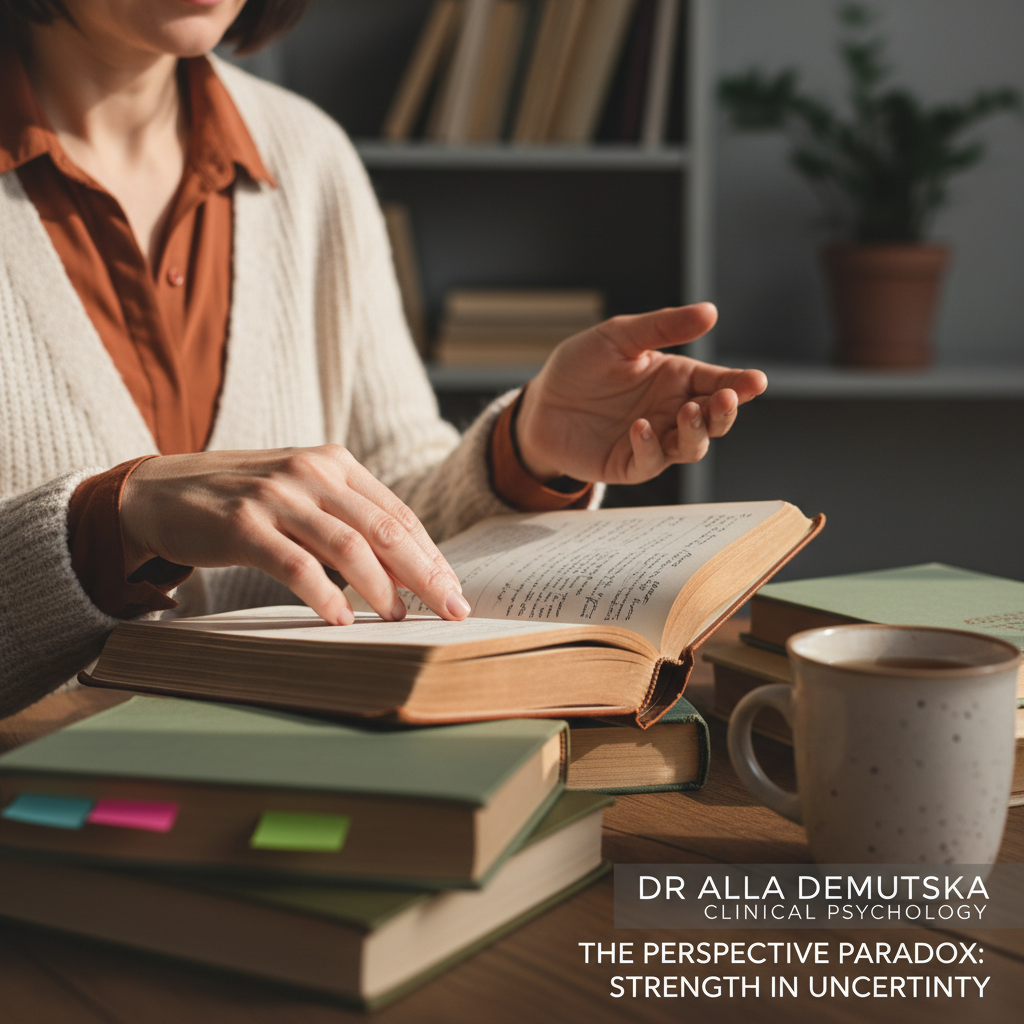
A clinical psychologist on why certainty in the wellness and coaching industry is often inversely related to expertise - and the cost to the people who trust it.
Read More →
Why do women lose friendships in midlife? A clinical psychologist on friendship dissolution, the performance self, and what the research suggests.
Read More →
Heartbreak interrupts the patterns we cannot see while inside them. A clinical psychologist on what romantic loss makes visible and why it matters.
Read More →
Why overthinking persists and makes decisions harder - the reinforcement trap, what drives the loop, and what actually interrupts it. A clinical psychologist's view.
Read More →
Why the impulse to escape difficult emotion makes psychological sense - and what the neuroscience of integration actually asks us to do instead.
Read More →
When the nervous system detects threat, logic often comes too late. Explore why co-regulation matters and why safety reaches further than instruction.
Read More →
Why extraordinary capability and psychological pain so often coexist - how high functioning develops as a trauma response, and what tends to break the spell.
Read More →The insight was real. The shift was real. And then, a few weeks later, you were back where you started. Why breakthroughs fade - and what actually makes change last.
Read More →
Why rage increases during perimenopause - the neurobiology of estrogen, the anterior cingulate cortex, and what decades of emotional labour have to do with it.
Read More →
What clinical psychology reveals about the midlife identity arc - from when things stop working to integration. Not a crisis. A threshold.
Read More →
Positive reframing is a useful skill, but used too early it becomes avoidance. A trauma-informed look at when reappraisal helps and when it bypasses feeling.
Read More →
Trauma can make love feel blind by fuelling projection and unspoken expectations. Explore resentment, intimacy, and returning to the present in relationships.
Read More →
Why high-achieving women experience an unexpected identity crisis at midlife - and what it means when competence stops feeling like enough.
Read More →
Where the loss of confidence in midlife actually comes from, and why it sounds so much like common sense.
Read More →
How to tell genuine acceptance from a numbing protector keeping emotion out of reach so you can function. A clinical psychologist on why the body is the test.
Read More →
Striving can look like ambition and still be organised around fear. Explore overfunctioning, self-worth, and why stopping can feel so threatening.
Read More →
Why do we pull away from people we trust? A trauma-informed look at protector parts, the exile beneath, and where relational healing actually happens.
Read More →
The collision between peak professional responsibility and perimenopausal transition - and what organisations and women need to know about the impact.
Read More →
A clinical psychologist explores why triggers become teachers only when the nervous system is regulated enough - and why omitting this can add to shame.
Read More →
Many people struggle with boundaries not because they are weak, but because they cannot clearly feel their own limits. Explore boundaries, walls, and self-contact.
Read More →
Reparenting is more than self-kindness. A trauma-informed look at the inner child, early attachment, and how self-abandonment becomes a pattern.
Read More →
Clinical psychologist Dr Alla Demutska explains primary vs secondary emotions, why venting fails, and what actually moves grief, fear and hurt through.
Read More →
Memory reconsolidation research shows traumatic memories can be updated, not erased. A clinical psychologist explains what this means for healing.
Read More →
Receiving care, praise, and visibility can feel harder than giving. Explore the shame, exposure, and nervous system patterns that make goodness hard to bear.
Read More →
Emotions are constructed, but the nervous system moves first. What clinical work with women teaches about the gap between activation and language.
Read More →
Avoidance and self-care can look identical. A clinical psychologist on how to tell which one is shaping your life - and why it matters over time.
Read More →
He never raised his voice and he was the most hurtful person I have been close to. What separates accommodating people from people who actually care.
Read More →
Splitting explains why you can see concerning behaviour in a relationship - register it fully - and still explain it away. A clinical psychologist's account.
Read More →
Many women feel guilt the moment they want more. Explore desire, conditioning, and why wanting more is not the same as ingratitude.
Read More →
Around 60% of perimenopausal women report problems with memory and concentration. What causes brain fog, why it threatens identity, and what the research shows.
Read More →
Menopause weight gain lands hardest on the woman who has always fixed things by working harder. Why effort stops working, and what does.
Read More →
A clinical psychologist explains why traumatic memory is stored differently in the brain - as sensory fragments, not narrative - and what this means for healing.
Read More →
Research shows positive affirmations can make people with low self-esteem feel worse. Here is what actually works, and why the wounded part needs listening, not arguing.
Read More →
Feeling invisible is not only something done to you. It is also something you start doing to yourself, earlier than anyone notices.
Read More →
Codependency is a nervous system adaptation that often emerges most strongly in romantic partnership. A clinical view.
Read More →
Discover why adverse childhood experiences predict perimenopausal depression and anxiety - and what the neuroscience tells us about trauma resurfacing, hormonal change, and treatment.
Read More →
Missing Bali is not dopamine withdrawal. It is the nervous system grieving the loss of co-regulation, community, and embodied environmental safety.
Read More →
Shame does not loosen because you told yourself a better sentence. Why the critic sounds like truth, and what actually shifts it.
Read More →
Why always being the strong one creates a specific loneliness - and why the capacity to receive is harder, and more important, than the capacity to give.
Read More →
Urgency, comparison, a debt you can never repay. What critic-driven effort feels like from the inside, and what genuine wanting feels like.
Read More →
How hot flashes and panic attacks present almost identically - and why treating anxiety without considering perimenopause means years of partial relief.
Read More →
What the FIGO international guidelines say about treating perimenopausal depression, where hormone therapy sits alongside antidepressants and psychotherapy, and what women are routinely not being offered.
Read More →
Why high-achieving women cannot stop even when ill - the nervous system equation that keeps productivity running, and what actually changes it.
Read More →
Do you need to heal before entering a relationship? Why trauma healing happens in relationships, not before them - through attachment and nervous system science.
Read More →
Self-betrayal is not only painful. It teaches the nervous system what to expect from you. Explore integrity, self-trust, and the inner witness.
Read More →
The voice stopped insulting you and started encouraging you. Same demand, softer register, and much harder to argue with.
Read More →
High-functioning men can lead companies and take physical risks but freeze when asked to feel. The clinical and neurobiological reasons inner work feels harder.
Read More →
Staying the same at midlife feels safe - but it has a hidden cost. The psychology of stagnation, avoidance, and what happens when women refuse the invitation to change.
Read More →
Learn how to distinguish growth discomfort from true misalignment. Trauma-informed insights on nervous system responses, career decisions, and psychological development.
Read More →
Psychological health is not a calm, steady state. Research on psychological flexibility and polyvagal theory shows it is the capacity to move between states.
Read More →
Explore the psychological difference between transformation coaching and therapy. How narrative models and formulation approaches shape change - and why your history matters.
Read More →
How fear and trauma travel across generations through the body - epigenetic research, the Ukrainian-Soviet inheritance, and what healing intergenerational trauma actually involves.
Read More →
Why midlife is the moment many women finally meet their own desire - and what it takes to stop apologising for it. A psychological perspective on wanting at the second half of life.
Read More →
A clinical psychologist explores how emotional invalidation in childhood leads to self-abandonment, codependency, and loss of interoceptive trust in adults.
Read More →
Self-abandonment in women begins in childhood emotional invalidation. A clinical psychologist on why we lose our needs and how the unlearning happens.
Read More →
People pleasing is not just kindness. Understand the trauma and attachment roots of self-abandonment, appeasement, and fast relational adaptation.
Read More →
Anger often rises in transition when old forms of self-suppression stop working. Explore anger as information, not just a problem to eliminate.
Read More →
A clinical psychologist responds to Lisa Feldman Barrett's argument that trauma is primarily about interpretation - and what the neuroscience actually shows.
Read More →
Memory reconsolidation shows that traumatic memories are not permanent. Here is what the research means for healing - and what it does not promise.
Read More →
How childhood trauma and dissociation shape adult fear of bodily sensation. A trauma-informed exploration of hypervigilance, attachment, and aliveness.
Read More →
Why perimenopausal women face a raised depression risk - and why prior trauma, ACEs, and current stress matter more than hormone levels alone.
Read More →
Why women in midlife and perimenopause experience more anger and irritability - and why it is not simply hormonal. A clinical perspective on structural fatigue, boundary failure, and emotional renegotiation.
Read More →
Not all trauma is dramatic. Explore developmental trauma, family survival roles, and the childhood stories that harden into adult identity.
Read More →
Feeling powerfully drawn to someone is not always a trustworthy signal. What trauma and attachment research says about attraction, familiarity, and the nervous system.
Read More →
Nervous system regulation can build capacity or become avoidance. A clinical psychologist on the pattern, the research, and how to tell the difference.
Read More →
Blunted cortisol after early adversity can look like calm. What a flat stress response changes about trauma therapy, and why insight alone rarely shifts it.
Read More →
Practical, psychologically-grounded strategies for protecting your mental health when your home becomes your office and the boundaries disappear.
Read More →There is a voice that shows up in the mirror. Most women I know have it. It does not wait to be invited - it arrives the moment you look, and it goes straight to what is wrong. This free guided practice will help you see yourself with the honest, loving attention you deserve.
There is a voice that tells you it is never quite enough. This free guide looks at why the inner critic developed, why trying to silence it does not work, and what does instead, with two short practices to begin.
Contact
If something here has landed for you - a recognition, a yes - I'd welcome hearing from you. There's no obligation. Just a conversation to see if we're a fit.
International · Online sessions available worldwide
Resources, reflections, and updates on upcoming programmes - for women navigating the second half of life, and for clinicians deepening their practice.
Thank you for joining. You'll hear from me when there's something worth sharing.
Choose how you'd like to reach Alla